
Team USA Brandenburg Cup: 7 Gold Medals in Dominant Displayv
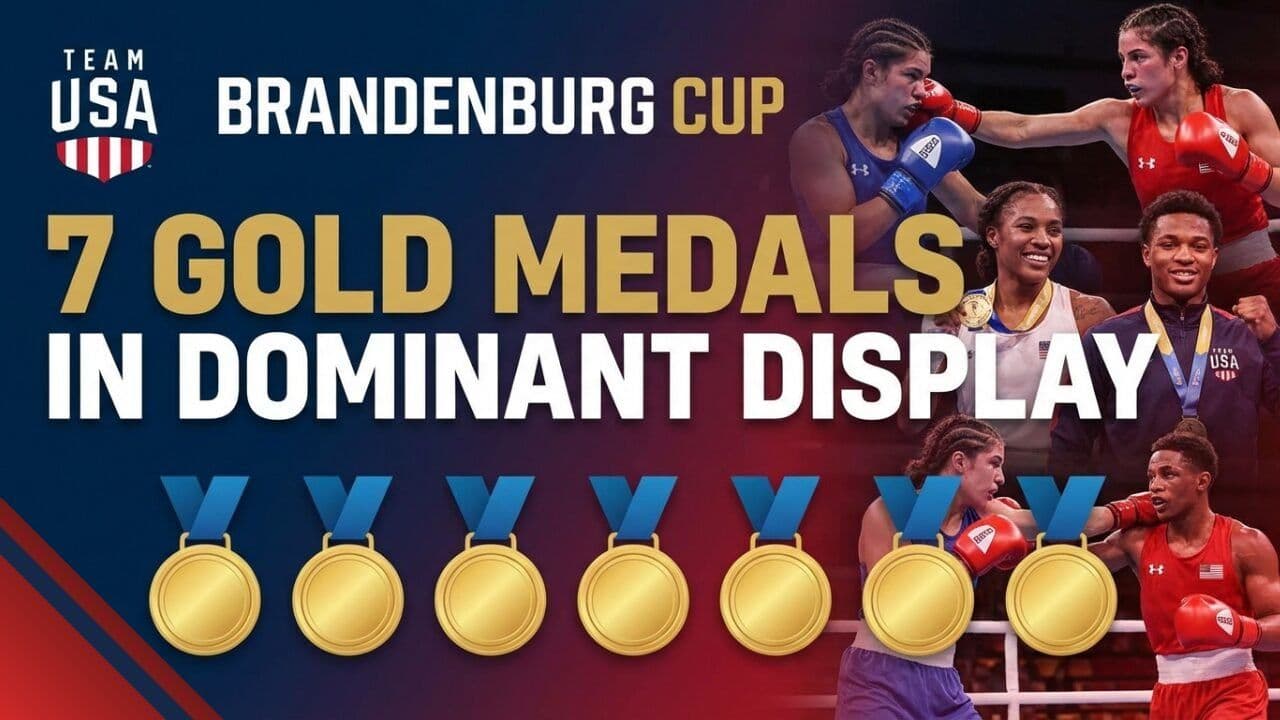
The Team USA Brandenburg Cup campaign delivered one of the most commanding performances in recent youth boxing history. Competing against top international prospects in Frankfurt (Oder), Germany, the American squad showcased depth, discipline, and championship composure. By securing seven gold medals and 11 total podium finishes, Team USA not only topped the medal standings but also reinforced the strength of its Youth High Performance program. More than just a successful tournament outing, the Team USA Brandenburg Cup results highlight a development system producing technically sharp, mentally resilient, and internationally competitive athletes ready for the next stage.
Key Takeaways
- Team USA secured 11 total medals, including 7 gold.
- All American finalists won their championship bouts.
- Both men’s and women’s divisions produced standout performances.
- The results strengthen USA Boxing’s long-term international outlook.
A Dominant Close in Germany
From the opening rounds to the final bell, the American squad displayed discipline and tactical sharpness. Seven athletes reached gold medal bouts and all seven left with victories. In international youth tournaments, finals can often go either way due to judging styles and regional familiarity. However, Team USA’s clean sweeps in championship matches reflected preparation and ring intelligence. Winning 11 medals out of 13 competing athletes demonstrates depth, not just isolated brilliance.
Medal Efficiency Compared
| Category | Team USA Performance | Typical International Average |
| Gold Medals | 7 | 3–4 |
| Total Medals | 11 | 6–8 |
| Finals Win Rate | 100% | 60–70% |
| Team Size | 13 | 12–15 |
Women Spark the Gold Rush
The women’s division set the tone early
Joscelyn Olayo-Munoz (48 kg) opened the championship stretch with relentless pressure and clean combinations to earn a unanimous decision over Italy’s Amelia Sula. Her performance combined aggression with control, a balance crucial in international scoring systems. Alexis Tangaro (54 kg) followed with a technical masterclass. Using disciplined footwork and calculated shot selection, she secured a 5-0 decision over Lithuania’s Jelizaveta Jakimova. Her ability to control distance proved decisive. Women’s boxing continues to be a cornerstone of American amateur success, and these results reinforce that upward trajectory.
Men’s Division Delivers Across Weight Classes
The men matched that momentum with precision and power.
Lorenzo Patricio (50 kg)
Patricio’s performance stood out for its technical excellence. His shutout victory over Australia’s Taj Harrington earned him Best Technician recognition, awarded to the most skilled competitor of the tournament.
Salim Ellis-Bey (60 kg)
Serving as team captain, Ellis-Bey demonstrated leadership through relentless pressure and ring control. He completed the event undefeated, finishing with a commanding decision in the final.
Lavant Brownlee (65 kg)
Brownlee navigated a challenging bracket, collecting multiple unanimous decisions and a stoppage before securing gold. His stamina and adaptability were key factors.
Joseph Awinongya (80 kg)
Awinongya delivered one of the tournament’s most emphatic finishes, landing a decisive right hand that ended his championship bout early. His power and timing separated him from the field.
Nnajai Wright (90+ kg)
Facing a taller opponent in Germany’s Ahmed Abdulgamidov, Wright executed a strategic game plan built around inside pressure and well-timed uppercuts to secure a 3-0 decision. These performances ensured that when headlines declared Team USA Wins 7 Golds at Brandenburg Cup, the statement was supported by substance across divisions.
Coaching Structure Behind the Success
Behind the athletes stood a unified coaching team led by head coach Edward Fonteneaux. Assistants Jason Hamilton and Ronald Wright provided tactical guidance throughout the tournament. A notable milestone was achieved with Yessenia Montalvo serving in a historic coaching role, adding representation and perspective within the program. In youth boxing, preparation extends beyond physical conditioning. Strategic adjustments between rounds and understanding international judging nuances often determine outcomes. The coaching staff’s cohesion played a visible role in maintaining composure during finals.
What This Means for USA Boxing’s Future
Success at the Brandenburg Cup serves as a valuable benchmark for athlete development. While youth victories do not guarantee elite medals, they indicate readiness to compete on broader stages. Historically, many Olympic contenders first proved themselves in European youth tournaments before transitioning to senior international events. The phrase Team USA Wins 7 Golds at Brandenburg Cup is not simply a tournament headline; it represents measurable progress in the national development system.
Real-World Example of Youth Success Translating to Olympic Glory
International youth tournaments have historically shaped future Olympic medalists. American standout Shakur Stevenson built his reputation through global junior competitions before earning silver at the 2016 Summer Olympics. Similarly, Claressa Shields dominated amateur circuits before winning gold at the 2012 Summer Olympics. Their early exposure to international judging styles and tournament pressure proved crucial. Performances like Team USA’s seven-gold showing at the Brandenburg Cup follow a similar developmental path, reinforcing how youth-level dominance often signals readiness for future elite and Olympic success.
Development Model Paying Off
Modern amateur boxing emphasizes
- International exposure at early stages
- Tactical video analysis
- Strength and conditioning science
- Mental resilience training
Compared to previous decades when development relied heavily on domestic competition, today’s structured pipeline provides athletes with global experience earlier in their careers. This shift has narrowed the gap between American youth boxers and traditionally dominant European programs.
Beyond the Ring: Character and Community
Joseph “JoJo” Awinongya’s journey reflects the human side of competition. After enduring multiple physically demanding bouts, he rallied in the final to secure gold dramatically. Upon returning home, he expressed plans to mentor young athletes in community programs, demonstrating that USA Boxing’s mission extends beyond medals. These athletes represent more than podium finishes; they embody leadership and resilience.
Global Context of the Brandenburg Cup
The Brandenburg Cup is regarded as one of Europe’s premier youth boxing tournaments. Nations such as Italy, Lithuania, Australia, and the host country, Germany, consistently field strong squads. For an American team to achieve a clean sweep in gold medal bouts on foreign soil speaks volumes about preparation and adaptability. When international observers assess tournament outcomes, efficiency matters. A team reaching multiple finals but winning few may raise questions about closing ability. In contrast, Team USA capitalized on every championship opportunity.
FAQs
What is the Brandenburg Cup?
An international youth boxing tournament held in Frankfurt (Oder), Germany, is attracting top emerging talent from around the world.
How many medals did Team USA win?
Team USA earned 11 medals, including seven gold and four bronze.
Why is this event important?
It provides high-level international experience and serves as a development milestone for athletes progressing toward elite competition.
Does this result impact Olympic preparation?
Strong youth-level international results improve readiness for elite transitions and future Olympic qualification pathways.
Conclusion
The Team USA Brandenburg Cup performance stands as a powerful indicator of the program’s upward trajectory. Winning seven gold medals on international soil reflects preparation, tactical intelligence, and a sustainable athlete pipeline. Beyond the medal count, the tournament demonstrated how structured development and early global exposure translate into measurable success. As these young boxers transition toward elite competition, the Team USA Brandenburg Cup achievement will be remembered as more than a headline; it marks a significant milestone in shaping the next generation of American boxing contenders.
Frequently Asked Questions
Q:What is the Brandenburg Cup?
An international youth boxing tournament held in Frankfurt (Oder), Germany, is attracting top emerging talent from around the world.
Q:How many medals did Team USA win?
Team USA earned 11 medals, including seven gold and four bronze.
Q:Why is this event important?
It provides high-level international experience and serves as a development milestone for athletes progressing toward elite competition.
Q:Does this result impact Olympic preparation?
Strong youth-level international results improve readiness for elite transitions and future Olympic qualification pathways.
Related Articles
 Boxing Training
Boxing Defense Mistakes to Avoid Complete Guide
Good boxing defense is not simply about keeping your hands high or moving your head. Effective defense combines stance, balance, footwork, distance management, timing, anticipation, positioning, guard recovery, and intelligent movement.
 Boxing Training
Slipping Punches Tips for Better Boxing Defense
The fastest way to improve your defense is not to move your head as much as possible. It is to move it at the right time, by the right amount, while staying balanced enough to counter.
 Boxing Training
Best Boxing Footwork Tips to Improve Your Boxing Skills
While powerful punches often steal the spotlight, they're only effective if your feet put you in the right position. Even the hardest punch loses its impact when your stance is unstable or your balance is off. Great footwork allows you to attack without overcommitting, defend without panicking, and control the pace of every exchange.