
Difference Between Boxing and Muay Thai Which Is Better
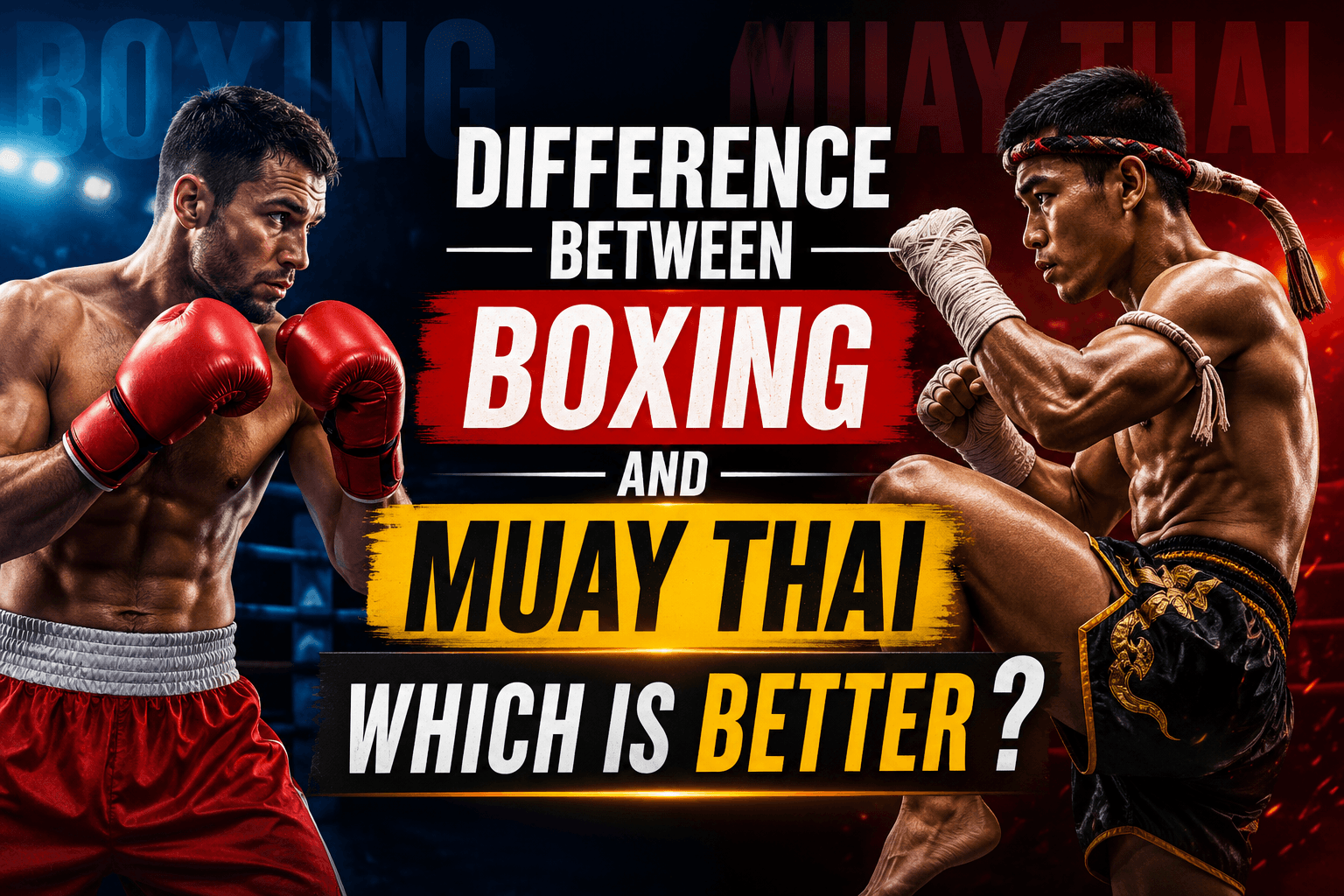
First and foremost, the arsenal used in boxing and Muay Thai is different. Be it improving your fitness, learning self-defense skills, becoming a professional fighter, or simply choosing a martial arts style that you would like, knowing how different martial arts styles compare can be very helpful.
Key Takeaways
- While boxing uses punches only, Muay Thai uses punches, kicks, elbows, knees, and clinch techniques.
- The attack techniques used in Muay Thai are more complete compared to those in boxing when it comes to self-defense.
- Boxing improves speed and precision of hands as well as mobility of head and feet.
- The use of muscles varies in Muay Thai and therefore is suitable for body exercise.
- Both the games are effective in improving endurance, strength, coordination, and discipline.
- It is slightly easier to learn boxing than Muay Thai owing to the former’s simplicity.
- Both the sports are good and it is impossible to say which one is superior to the other since this will depend on what you want to achieve through your workout.
Quick Comparison Boxing vs Muay Thai
| Feature | Boxing | Muay Thai |
|---|---|---|
| Main Weapons | Punches only | Punches, kicks, elbows, knees, clinch |
| Nickname | Sweet Science | Art of Eight Limbs |
| Country of Origin | England | Thailand |
| Olympic Sport | Yes (Amateur) | IOC Recognized, not Olympic |
| Footwork | Fast, light, mobile | Balanced, stable, kick-ready |
| Defensive Style | Slips, rolls, blocks | Checks, blocks, clinch, evasions |
| Clinch Fighting | Minimal | Major scoring technique |
What Is Boxing?
Boxing is one of the world's oldest and most popular combat sports, dating back thousands of years and evolving into the modern sport governed by standardized rules. Fighters rely exclusively on punches delivered with speed, precision, timing, and power.
A boxer can score using:
- Jab
- Cross
- Hook
- Uppercut
Success depends on:
- Footwork
- Head movement
- Defensive positioning
- Counterpunching
- Ring IQ
- Endurance
Because only punches are allowed, boxing places exceptional emphasis on mastering distance, angles, combinations, and defensive reactions. Elite boxers spend years refining subtle movements that make their offense more effective while minimizing the chances of being hit.
Core Abilities Gained Through Boxing
- Punching ability
- Fast hands
- Defensive skills
- Endurance
- Coordination
- Rhythm
- Resilience of mind
What Is Muay Thai?
Muay Thai was developed in Thailand and is now one of the most effective forms of striking martial arts in the world. It is also well-known due to its real-life uses and effects on modern mixed martial arts.
In contrast to boxing, Muay Thai involves eight areas of impact used by the fighter:
- Two fists
- Two elbows
- Two knees
- Two shins/feet
It is for this reason that it is referred to as The Art of Eight Limbs.
Besides striking techniques, Muay Thai also stresses clinching techniques where practitioners control their opponent’s stance and deliver knee strikes, elbow strikes, trips, and off-balance techniques.
Core Skills Developed in Muay Thai
- Powerful kicks
- Effective elbow strikes
- Knee attacks
- Clinch control
- Balance
- Full-body conditioning
- Defensive adaptability
Difference Between Boxing and Muay Thai
Although both sports involve striking, they are built on very different systems.
1. Techniques
The biggest difference lies in the variety of offensive weapons available.
Boxing Allows
- Jab
- Cross
- Hook
- Uppercut
Muay Thai Allows
- Punches
- Roundhouse kicks
- Teep kicks
- Elbows
- Knees
- Clinch strikes
- Sweeps (under rule variations)
As a result, Muay Thai athletes must train in far more offensive and defensive scenarios than boxers.
2. Stance
Boxing Stance
A boxing stance is narrower and lighter.
Characteristics include:
- Weight slightly forward
- Constant movement
- Faster pivots
- Quick directional changes
- Better punching angles
This stance maximizes punching speed but leaves the lead leg more vulnerable to kicks, something that isn't a concern under boxing rules.
Muay Thai Stance
Muay Thai uses a more upright and balanced posture designed to defend against kicks while allowing powerful strikes from all limbs.
Characteristics include:
- Even weight distribution
- Stable base
- High guard
- Ready to check kicks
- Efficient balance during clinch exchanges
3. Footwork
One of the most noticeable differences between boxing and Muay Thai is footwork.
Boxing Footwork
Boxers are constantly moving.
They use:
- Angles
- Circles
- Pivots
- Lateral movement
- Quick entries
- Fast exits
This mobility helps create openings while avoiding incoming punches.
Muay Thai Footwork
Muay Thai movement is more measured.
Instead of constantly bouncing around the ring, practitioners stay balanced to:
- Defend kicks
- Deliver powerful kicks
- Enter the clinch
- Maintain stability after striking
While boxing prioritizes speed of movement, Muay Thai prioritizes balance and striking readiness.
Defensive Differences
Defense is another area where the two sports diverge significantly.
Boxing Defense
Boxers defend primarily using upper-body movement and hand positioning.
Common defensive techniques include:
- Slipping punches
- Bobbing and weaving
- Rolling under hooks
- Parrying
- Catching punches
- Blocking
- Counterpunching
Since kicks and knees are not allowed, the defense focuses almost entirely on punches.
Muay Thai Defense
Muay Thai requires defending against attacks from every direction.
Practitioners learn to:
- Check kicks with the shin
- Block punches
- Catch kicks
- Evade strikes
- Control opponents in the clinch
- Defend elbows
- Neutralize knee attacks
Because there are more legal attacks, defensive training is broader and often takes longer to master.
Punching Power
Many beginners assume Muay Thai fighters punch harder because they train more weapons, but the reality is more nuanced.
Boxers dedicate nearly all of their striking practice to developing:
- Punching mechanics
- Hip rotation
- Shoulder engagement
- Speed
- Precision
- Combination punching
Elite boxers are really good at punching. They are very good at throwing punches.
Muay Thai fighters do things differently. Muay Thai fighters practice punching. Muay Thai fighters also do kicking. Muay Thai fighters use their elbows and knees to fight.
Kicking Power
This is where Muay Thai clearly stands apart.
Roundhouse kicks in Muay Thai generate tremendous force by rotating the hips and driving through the target with the shin rather than the foot.
Common kicks include:
- Roundhouse kick
- Teep (push kick)
- Low kick
- Body kick
- High kick
Since boxing prohibits kicking entirely, this aspect of striking is absent from boxing training.
Expert Insight
One of the biggest mistakes beginners make is choosing a martial art based solely on which appears more powerful. In reality, the better choice depends on your personal goals.
- If you really want to be great at punching, have footwork and be able to defend yourself well then boxing is a good way to go. It helps you develop these skills in a lot of detail.
- If you want to learn how to fight with your body, including punches, kicks, elbows, knees and fighting when you are close to someone Muay Thai is a better choice. Muay Thai teaches you a lot of skills.
The best martial art for you is the one that you can keep practicing that you like enough to stick with and that you feel comfortable using in a fight. You have to like Muay Thai or boxing to get good at it.
Training Differences Between Boxing and Muay Thai
Although both sports improve fitness and fighting ability, their training sessions are structured differently.
A typical class in either discipline includes:
- Warm-up
- Technique drills
- Pad work
- Heavy bag training
- We have things we do in each session of Sparring depending on how much experience you have.
- We also do Strength and conditioning to make you stronger.
- Then we do Cool-down to help our bodies relax.
- However the focus of each session of Sparring varies.
Boxing Training
A boxing workout is heavily centered around developing exceptional hand speed, timing, precision, and endurance.
Typical boxing drills include:
- Shadow boxing
- Jump rope
- Heavy bag work
- Focus mitt drills
- Speed bag training
- Footwork ladder drills
- Defensive movement exercises
- Combination punching
Since boxing uses only punches, athletes spend thousands of repetitions refining every movement until it becomes instinctive.
What You'll Improve
- Hand-eye coordination
- Reflexes
- Punching speed
- Cardiovascular endurance
- Timing
- Agility
Muay Thai Training
Muay Thai training is really good for your body because it combines hitting, grabbing and getting in shape.
A typical session may include:
- Shadow boxing with kicks
- Pad work
- Heavy bag training
- Clinch drills
- Knee and elbow combinations
- Kick repetitions
- Sparring
- Body conditioning
Shin conditioning and clinch practice are unique aspects of Muay Thai that require patience and consistent practice.
What You'll Improve
- Explosive power
- Balance
- Flexibility
- Core strength
- Full-body coordination
- Overall athleticism
Which Burns More Calories?
If your primary goal is weight loss, both sports are excellent choices.
The actual number of calories burned depends on factors such as:
- Body weight
- Training intensity
- Session duration
- Experience level
- Rest intervals
Estimated Calories Burned (60 Minutes)
| Activity | Calories Burned ▼ |
|---|---|
| Boxing | 600–900 |
| Muay Thai | 700–1,100 |
Muay Thai often burns slightly more calories because it engages more muscle groups through kicks, knees, elbows, and clinch work.
Winner for Weight Loss
Muay Thai has a slight advantage, but consistent training in either sport combined with proper nutrition can produce excellent fat-loss results.
Muscle Groups Worked
Boxing
Boxing primarily targets:
- Shoulders
- Chest
- Triceps
- Forearms
- Core
- Back
- Legs (for movement and power generation)
Boxing is a sport that involves throwing punches with the body.. The thing is, good boxing is not just about the upper body. It is really about the legs and the hips. You see, leg drive and hip rotation are very important in boxing. The legs and hips help the boxer to throw punches. So boxing is about the legs and the hips and how they work together with the upper body to throw punches. Boxing relies heavily on leg drive and hip rotation.
Muay Thai
Muay Thai uses every big muscle in the body.
These include:
- Quadriceps
- Hamstrings
- Glutes
- Calves
- Core
- Back
- Chest
- Shoulders
- Arms
- Hip flexors
When you do kicks and knees in Muay Thai you need to be really strong in your body to do them properly. This is why Muay Thai is so good for your body. It helps you get stronger over not just in one area. Muay Thai and hip flexors are connected because hip flexors are used when you do kicks. Hip flexors are important for Muay Thai.
Which Is Better for Self-Defense?
One of the common questions people who are new to fighting ask is whether boxing or Muay Thai is better when you are actually in a fight.
The answer to this question is not simple. It depends on what is happening.
Why Boxing Is Effective
Boxing teaches:
- Accurate punches
- Fast reactions
- Distance management
- Defensive awareness
- Quick footwork
In close-range confrontations, these skills can be extremely valuable.
Why Muay Thai Is Effective
Muay Thai expands your defensive options by teaching:
- Powerful kicks
- Knee strikes
- Elbows
- Clinch control
- Sweeps (depending on rules)
These techniques make Muay Thai more versatile when dealing with different types of attacks.
Injury Risks
Like all contact sports, both boxing and Muay Thai carry a risk of injury.
Common Boxing Injuries
- Wrist sprains
- Hand fractures
- Shoulder strain
- Nose injuries
- Facial cuts
- Concussions
When you are boxing it is very important to wrap your hands. You should also use quality gloves.. When you are sparring with someone make sure you are in control. These things can really help reduce the risks of getting hurt when you are boxing. Proper hand wrapping and quality gloves are very important. Controlled sparring is also very important. Proper hand wrapping can help reduce the risks. Quality gloves can also help reduce the risks. Controlled sparring is another way to reduce the risks.
Common Muay Thai Injuries
- I get these injuries a lot. I get shin bruises from doing sports. Sometimes I also get ankle sprains. My knee gets a strain from running. I even get cuts from my elbows when I fall.
- Foot injuries
- Rib bruises
People who are just starting out often get shins when they are learning how to kick. This is because their body is not used to kicking techniques.. The soreness in the shins usually goes away when they learn how to do the kicking techniques properly.
Equipment Comparison
Boxing Equipment
To start boxing you will usually need:
- Boxing gloves
- Hand wraps
- Mouthguard
- Boxing shoes (optional, for beginners)
- Jump rope
- bag (home training)
Muay Thai Equipment
In addition to gloves and hand wraps people who do Muay Thai usually need:
- Shin guards
- Mouthguard
- Ankle supports if needed
- Muay Thai shorts
- Groin protection when they are sparring
- Elbow pads in some gyms
Because of all the safety equipment the first time you buy everything it costs more than when you buy gear for boxing.
Monthly Training Costs
Prices are different depending on where you're and the gym you go to but here is a general idea of what you might pay.
- The expense of training can vary
- The cost of boxing classes is different
- The price of Muay Thai lessons can also be different
- The cost of a gym membership can change
- The cost is moderate
- The cost is moderate to high
- Beginner Equipment
- The cost is lower
- The cost is higher
- Competition Cost
- The cost is moderate
- The cost is moderate
- Private Coaching
- The cost is similar
- The cost is similar
When you first start Muay Thai you have to pay more for the equipment.. After that the cost of Muay Thai and Boxing are generally the same. Muay Thai and Boxing have costs when it comes to what you pay every month. Muay Thai and Boxing are much the same when you look at how much they cost overall.
How Long Does It Take to Become Good?
Progress depends on:
- Training frequency
- Coaching quality
- Athletic background
- Consistency
- Sparring experience
General Timeline
3–6 Months
- Basic techniques
- Improved fitness
- Better coordination
6–12 Months
- Confident sparring
- Strong fundamentals
- Better conditioning
1–3 Years
- Intermediate skill level
- Local competition readiness
- Advanced combinations
3–5+ Years
- Advanced technical proficiency
- Coaching opportunities
- Competitive experience
Boxing can feel simpler in the beginning because there are not techniques to master. Muay Thai is harder to learn at first. That is because Muay Thai includes types of strikes. It also involves close combat work. The learning process for Muay Thai takes longer. The learning process for Muay Thai is more difficult. The learning process for Muay Thai is not as easy as the learning process for Boxing. The learning process for boxing is not as difficult as the learning process for Muay Thai. The learning process for boxing is easier than the learning process for Muay Thai. The learning process for Muay Thai is more complex than the learning process for Boxing.
Can You Train Both?
Absolutely.
Many athletes mix boxing and Muay Thai to become strikers.
Benefits of Cross Training
- Better punching technique
- Improved kicking ability
- Stronger footwork
- Enhanced conditioning
- Greater adaptability
More confidence in different combat situations
This combination is really good for people who like arts or just want to learn how to strike in different ways. Mixed martial arts is a way to stay active and learn things about martial arts. People who do arts can stay active and learn new things about martial arts. If you are into martial arts then this combination is very useful for you.
Boxing vs Muay Thai at a Glance
| Goal | Better Choice |
|---|---|
| Learn Powerful Punches | Boxing |
| Full-Body Striking | Muay Thai |
| Faster Footwork | Boxing |
| Better Kicking Skills | Muay Thai |
| Weight Loss | Muay Thai |
| Cardio Fitness | Tie |
| Beginner-Friendly | Boxing |
| Self-Defense | Muay Thai |
| Olympic Competition | Boxing |
| Overall Striking Variety | Muay Thai |
Should You Choose Boxing or Muay Thai?
If you're still undecided, don't worry there's no one-size-fits-all answer. The right choice depends on your goals, fitness level, and what motivates you to train consistently.
Choose Boxing If You Want To
- Improve punching speed and accuracy
- Develop elite footwork and head movement
- Compete in amateur or Olympic-style boxing
- Focus on one striking discipline
- Learn a sport with a simpler technical foundation
- Build cardiovascular endurance through fast-paced movement
Best For
- Beginners
- Fitness enthusiasts
- Competitive athletes
- People who enjoy technical precision
Choose Muay Thai If You Want To
- Learn a complete striking system
- Improve self-defense skills
- Burn more calories during training
- Develop full-body strength and conditioning
- Learn kicks, knees, elbows, and clinch fighting
- Transition into MMA later
Best For
- Self-defense learners
- Martial arts enthusiasts
- MMA beginners
- People seeking full-body workouts
Decision Guide
Use this quick guide to determine which discipline best matches your goals.
| Your Goal | Recommended Sport |
|---|---|
| Lose Weight | Muay Thai |
| Learn Self-Defense | Muay Thai |
| Master Punching | Boxing |
| Improve Footwork | Boxing |
| Build Confidence | Either |
| Train for MMA | Muay Thai |
Expert Tips for Beginners
If you're new to combat sports, these tips can help you build a strong foundation:
- Focus on mastering technique before increasing power.
- Invest in quality protective equipment from the beginning.
- Don't compare your progress with experienced fighters.
- Prioritize consistency over intensity.
- Always warm up and cool down properly.
- Listen to your coach and avoid rushing into hard sparring.
- Recovery, sleep, and nutrition are as important as training.
Conclusion
The difference between boxing and Muay Thai goes far beyond the number of techniques each sport allows. Boxing is a refined striking discipline centered on speed, precision, movement, and world-class punching mechanics. Muay Thai, by contrast, is a comprehensive striking art that incorporates punches, kicks, knees, elbows, and clinch fighting for a more versatile approach.
Whichever path you choose, consistent training, quality coaching, and disciplined practice will have the greatest impact on your progress.
Frequently Asked Questions
Q:Is it better to learn Muay Thai or boxing?
For self-defense, Muay Thai is often more practical because it teaches you to fight using kicks, punches, and clinch techniques, while boxing mainly focuses on punches.
Q:Is boxing better than Muay Thai for fat loss?
Both boxing and Muay Thai burn lots of calories. Muay Thai may burn a little more because it uses kicks and clinch moves that work your whole body.
Q:Can a boxer beat a Muay Thai fighter?
It depends on the rules, experience, and environment. Under boxing rules, the boxer has a clear advantage. Under Muay Thai rules, the Muay Thai practitioner benefits from kicks, elbows, knees, and clinch techniques. Individual skill is more important than the style itself.
Q:What is the best martial arts for self-defense?
BJJ is one of the best martial arts for self-defense. It teaches you to control an attacker on the ground and stay safe without relying on punches or kicks.
Q:Can I train both boxing and Muay Thai?
Yes. Many athletes successfully combine both disciplines. Boxing sharpens punching accuracy and footwork, while Muay Thai adds kicks, knees, elbows, and clinch skills, creating a well-rounded striking foundation.
Related Articles
 Boxing Training
Southpaw Stance Mistakes to Avoid 11 Common Errors
Most southpaws hear the same thing on day one: being left-handed is an advantage, opponents hate fighting you, enjoy the free lunch. Then they spend two years eating right hands and wondering where the free lunch went. The southpaw stance mistakes to avoid are rarely dramatic.
 Boxing Training
Boxing Defense Mistakes to Avoid Complete Guide
Good boxing defense is not simply about keeping your hands high or moving your head. Effective defense combines stance, balance, footwork, distance management, timing, anticipation, positioning, guard recovery, and intelligent movement.
 Boxing Training
Slipping Punches Tips for Better Boxing Defense
The fastest way to improve your defense is not to move your head as much as possible. It is to move it at the right time, by the right amount, while staying balanced enough to counter.