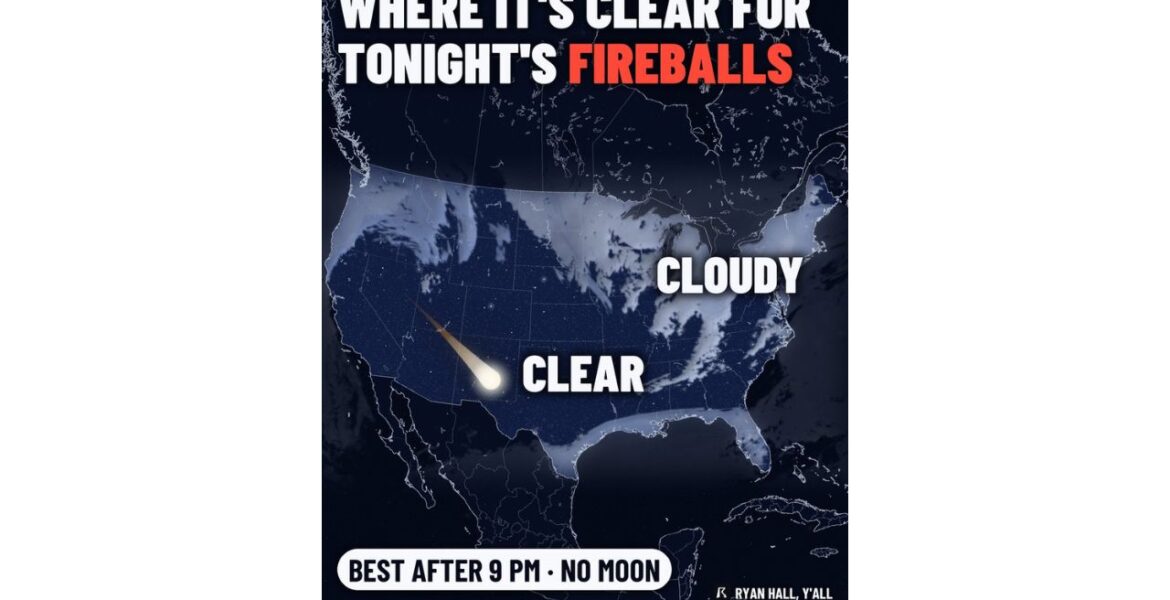
OKLAHOMA — Tonight’s meteor shower may be a small one, but it is famous for something special: big, slow fireballs. The Taurid meteor shower is active on Wednesday night November 11, and viewing is best after 9:00 PM with no moon in the sky. Our cloud forecast shows the Southwest, Oklahoma, most of Texas and Arkansas with clear skies, giving those areas the best shot at catching one.
A Small Shower With a Big Reputation
The Taurids do not produce a lot of meteors, so this is not a night for nonstop shooting stars. What makes them worth watching is their tendency to drop the occasional fireball, a meteor so bright it can light up the whole sky for a second or two.
Taurid fireballs also tend to move slowly across the sky. That gives viewers more time to spot them and follow their path before they fade away.
Oklahoma, Texas and Arkansas Get the Best View
Our cloud forecast for 12:00 AM ET Thursday November 12 shows a large clear area across the southern and western parts of the country:
- Oklahoma looks clear across almost the entire state.
- Texas stays mostly clear, especially across the central, northern and western parts of the state.
- Arkansas is expected to have clear skies for much of the night.
- The Southwest, including Arizona, New Mexico, Nevada and Utah, looks wide open.
- Much of the central Rockies and Plains, including Colorado and Kansas, also shows clear skies on the map.
Clouds Blanket the Great Lakes and Northeast
Not everyone will be as lucky. A thick area of clouds stretches across the Great Lakes, Ohio Valley and Northeast, covering much of the region where storms moved through on Wednesday. Clouds also cover parts of the northern Plains and the Pacific Northwest.
Along the Gulf Coast and in Florida, clouds hug the shoreline, which could block views near the coast. Inland areas just away from the water may have better luck.
Why Taurid Fireballs Move So Slowly
The Taurids come from a stream of debris left behind by a comet. Compared with many other meteor showers, these pieces hit Earth’s atmosphere at slower speeds. That slower speed makes them drift more gently across the sky.
Some of the pieces in the Taurid stream are also larger than typical meteor dust. When a bigger piece burns up, it can create a bright fireball that may even leave a glowing trail behind.
After 9 PM With No Moon Is the Sweet Spot
Timing is simple tonight. Viewing improves after 9:00 PM, once the sky is fully dark. With no moonlight, even fainter meteors will be easier to spot, and any fireball will stand out sharply against the dark sky.
The later you stay up, the better your chances, as long as clouds stay away.
One Cloud Forecast, So Check Again Tonight
Our cloud map is based on a single forecast run, so conditions could still change. Clouds can thin out or move in faster than expected. Stepping outside to check the sky before settling in is always a good idea.
Tips for Spotting a Fireball
- Get away from bright city lights for the darkest possible sky.
- Give your eyes about 20 to 30 minutes to adjust, and avoid looking at your phone screen.
- Lie back and look at a wide part of the sky, since fireballs can appear anywhere.
- Dress warmly, as November nights can turn cold quickly.
- Bring a blanket or chair so you can watch comfortably for a long stretch.
- Be patient, since fireballs are rare and may come with long gaps in between.
Boxingessential.com will continue tracking sky conditions for the Taurid meteor shower across Oklahoma, Texas, Arkansas and the Southwest and will provide updates as cloud cover, fireball sightings and upcoming sky events develop.
You may also like
Leave a Reply