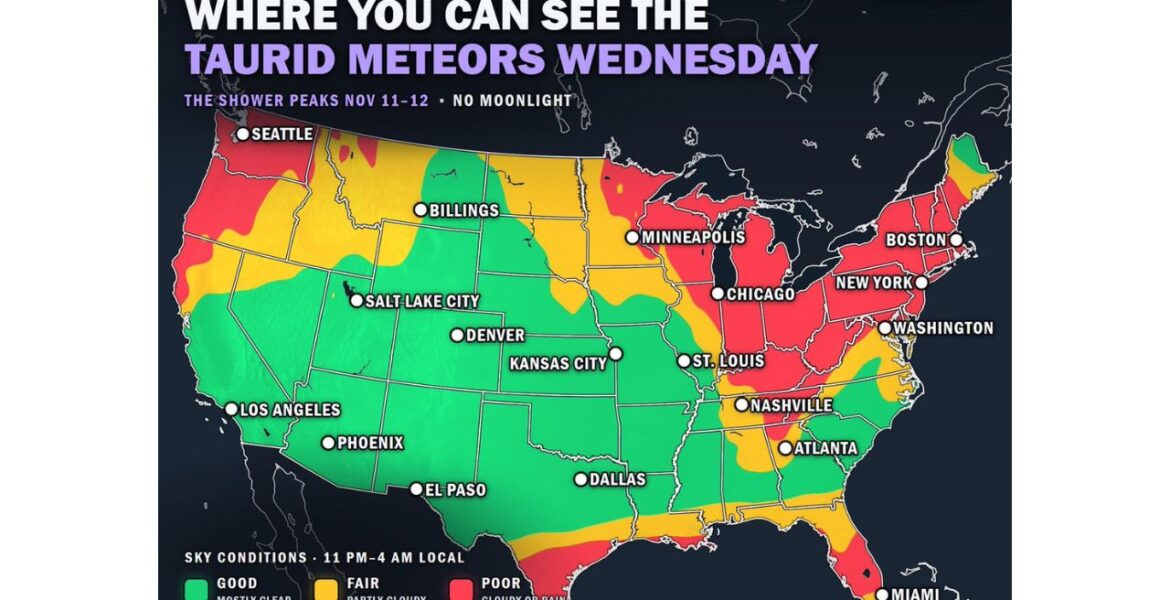
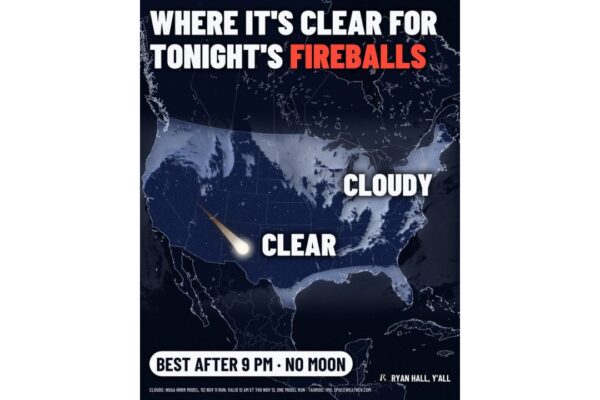
DENVER, Colorado — The Northern Taurid meteor shower peaks from Wednesday night November 11 into Thursday morning November 12, and there will be no moonlight to get in the way. While this is a slow shower, with about 5 meteors an hour from a dark spot, it is known for producing the occasional bright fireball. Our cloud forecast shows the West and Plains with the clearest skies, while clouds and rain cover the Great Lakes, Northeast and Pacific Northwest.
Key Numbers at a Glance
| Detail | Information |
|---|---|
| Peak | Wednesday night November 11 into Thursday November 12 |
| Best viewing window | 11:00 PM to 4:00 AM local time |
| Meteors per hour | About 5 from a dark location |
| Special feature | Occasional bright fireballs |
| Moonlight | None, giving darker skies |
| Best skies | West and Plains |
| Worst skies | Great Lakes, Northeast and Pacific Northwest |
Where It Is Hitting
Our viewing map splits the country into three groups based on expected skies from 11:00 PM to 4:00 AM local time:
- Good, mostly clear skies cover Salt Lake City, Denver, Kansas City, Los Angeles, Phoenix, El Paso and Dallas.
- Fair, partly cloudy skies sit near Billings, Minneapolis, St. Louis, Nashville and Atlanta, where breaks in the clouds could still allow viewing.
- Poor, cloudy or rainy skies cover Seattle, Chicago, New York, Boston, Washington and Miami.
Much of Colorado, Kansas, Oklahoma, Texas, New Mexico, Arizona and Utah looks especially promising.
When to Expect It
- Wednesday evening: Skies darken, and the shower begins to pick up after sunset.
- 11:00 PM local time: The best viewing window opens as the sky gets fully dark.
- Midnight to 2:00 AM: Often a good time to watch, with the shower’s source high in the sky.
- 4:00 AM local time: The best window ends as dawn approaches.
Why This Is Happening
The Taurid meteor shower happens when Earth passes through a stream of dust and small rocks left behind by a comet. As those pieces hit our atmosphere at high speed, they burn up and create streaks of light. The Taurids move more slowly than many other meteor showers, which can make them easier to spot.
Some of the pieces in the Taurid stream are larger than usual. When they burn up, they can create fireballs, which are extra bright meteors that can light up the sky for a moment.
What This Means for You
With only about 5 meteors an hour, patience is key. You may wait several minutes between meteors, but the chance of seeing a bright fireball makes it worth it. No telescope or binoculars are needed, since meteors are best seen with your eyes across a wide part of the sky.
People in the West and Plains have the best shot at clear skies. Those in the Great Lakes and Northeast may have to try again another night, as Taurid meteors are often visible for several nights around the peak.
How to Stay Safe and Get the Best View
- Get away from city lights to see more meteors and fainter streaks.
- Give your eyes 20 to 30 minutes to adjust to the dark, and avoid looking at your phone.
- Dress warmly, since late-night temperatures in November can be cold.
- Bring a blanket or reclining chair so you can comfortably look up for long periods.
- Tell someone where you are going if you head to a remote viewing spot.
- Check the cloud forecast before heading out in case conditions change.
Boxingessential.com will continue tracking sky viewing conditions for the Taurid meteor shower across Colorado, Missouri and Texas, including Denver, Kansas City and Dallas, and will provide updates as cloud cover and upcoming sky events develop.
You may also like
Leave a Reply